|
Hull Cartridge 28g No 9s plastic wad and fibre wad compared
I have heard it said that the plastic
wad and cup was the biggest advance in shotgun ballistics since the choke was invented.
However, some ranges insist on the use of fibre wads (it is
worth noting that although some plastic wads are photodegradable, this is
not the same as biodegradable). In their mind, shooters often think of fibre wads as a
disadvantage. The reasons cited are shot deformation when it passes through
the forcing cone and choke, galling of the lead as it speeds down the bore
and the wad running into the back of the shot once it has left the barrel.
The common belief is that plastic wads are much superior.
However, when most people think of
superior patterns they tend to think in terms of tighter patterns. When
shooting smaller sized shot at closer targets, a tighter pattern is not an
advantage. In fact if the targets are close and the plastic wad shell
gives a tighter pattern then a more open choke would be used.
So, for close range targets,
repeatability of spread is more important than potentially minimising the
pattern width (and hence maximising the range). 'Goodness' of pattern,
however, is still important. Although a large number of small pellets will
be used, the ideal is to spread them as wide as possible without large
gaps appearing in the centre of the pattern so this is where
the fibre wad may display some weaknesses.
To test for the differences in
patterning Hull Cartridge ProOne 28g No.9s with plastic wads are compared with
Hull ProFibre 28g No.9 fibre wads. The ProOnes have a claimed
muzzle velocity of 1500fps and the ProFibre 1450fps. Both have shot with
5% antimony. Both are mid-priced
shells. The pellet count from unfired shells was 525 for the fibre and 514
for the plastic wad which is close enough to allow direct comparisons of
the pellet coverage.
The ProFibre is a popular choice for
skeet shooting (in the UK) because of its medium recoil and its assumed
wide pattern (a lot of skeeters are always looking for a wider pattern!).
Hence the gun used for testing is a 27.5"
Miroku 6000 skeet gun.
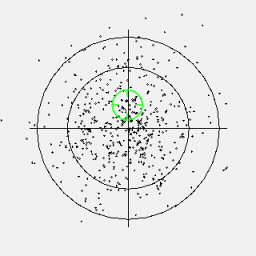
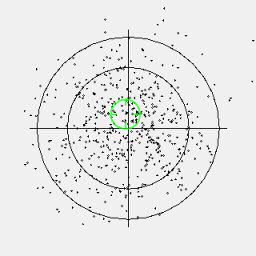
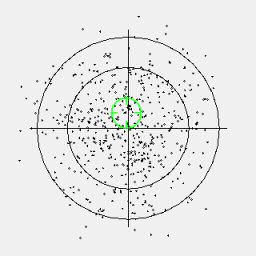
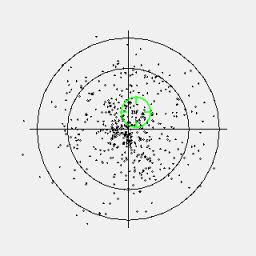
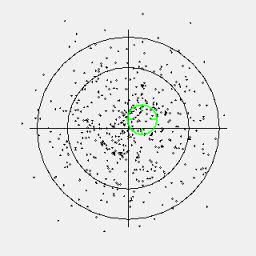
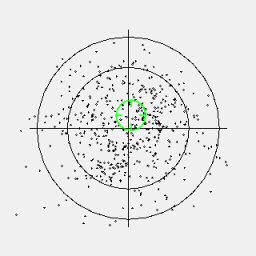
Individual patterns and
average pattern width.
Fibre wad patterns and
spread summary.
Patterns and overall summary of Hull ProFibre
28g No9 fired from 17yds.
Average Spread
|
Average shot to shot variation
|
|
20.84" |
+/- 0.66" (3.2%) |
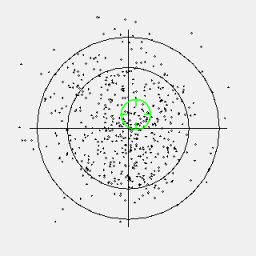
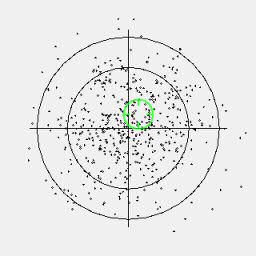
Plastic wad
patterns and spread summary.
Patterns and overall summary of Hull ProOne plastic
wad 28g No9 fired from 17yds.
Average Spread
|
Average shot to shot variation
|
|
19.54" |
+/- 1.73" (8.9%) |
It can be seen that the average
spread of the plastic wad shells at 19.54" is about 7% tighter than
that of the fibre wads at 20.84" (the spread figure is the diameter
that accounts for 75% of the pellets). For practical purposes, they
are fairly similar. This spread difference is what one might expect
between cylinder and skeet chokes.
In total, eight different shells have
been tested through the Miroku. Compared with all of these, the ProOne
plastic wad throws the tightest pattern by quite a margin - it is about 12%
tighter pattern than the most open. The Hull fibre wad is near the middle
of the range.
Analysis
of shot to shot repeatability.
If one could only look at the patterns by eye,
it would be very hard to rate the two shells. However, the numerical
analysis reveals the repeatability of spreads of +/-
3.2%
and +/- 8.9% for the fibre and plastic wad respectively and this is where the
differences in shell performance come to the fore. The plastic wad is the
least repeatable of all shells tested with the Miroku. The Hull ProFibre
is one of the best. The difference between these two becomes obvious when
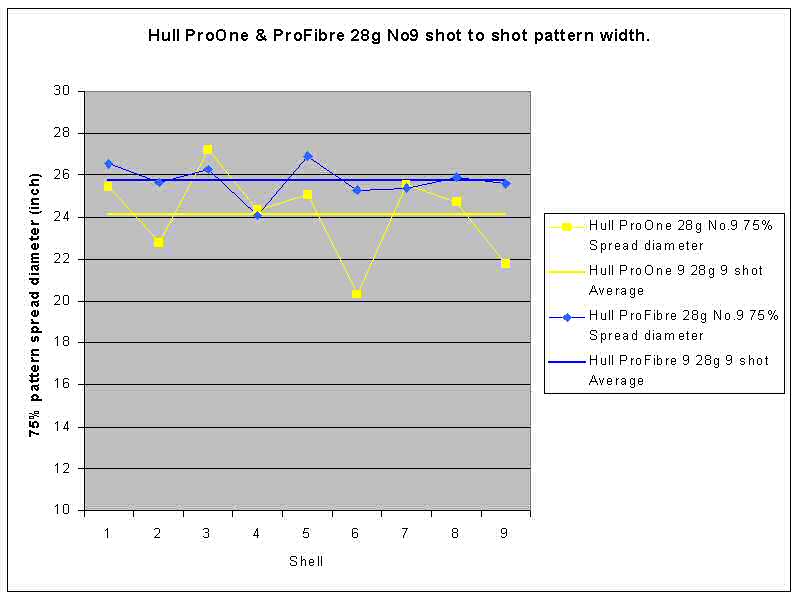
a plot is made of how the spread varied shot to shot. (NB the graph below
uses data from the patterns fired at 17yds and scaled to 21yds - the
centre peg on skeet)
The graph below shows clearly that
the fibre wad is very repeatable. The plastic wad really isn't working
well with this gun with an extreme range of values in spread of ~30%. It
is worth noting that the most open patterns of the plastic wad shell are near the
average spread of the fibre wad shell. Put subjectively, the plastic wad shell
is not throwing open patterns and then really tight ones but it's
range is from 'normal' (as determined by the fibre wad baseline) to very,
very tight patterns. Compared with the fibre wad shell, on a skeet layout,
the plastic wad would be occasionally robbing the shooter of spread.
Whether this matters is another
story! But purely in terms of matching shells to gun, the fibre wad works,
this particular plastic wad does not.
To give these repeatability figures
some perspective, several other plastic wad shells have been tested both in 24g and
28g. They offer very good repeatability in the range of 2.5% - 4.5%
average shot to shot variation. Their spreads are similar to the Hull
fibre wad with the faster shells giving slightly wider spreads.
Shot
to shot spread of Hull ProFibre and ProOne (plastic wad) 28g No9 shot.
(Shot at 17yds and scaled to 21yds)
The results thus far have found that
the fibre wad is much more repeatable in terms of spread. This could help
a skeet shooter on the closer targets or when slightly off the line of the
clay or for one who shoots quickly and wants a wider repeatable spread to
help this style of shooting.
Some people claim that the fibre wad
can disrupt the pattern, especially the centre of the pattern when the wad
runs into the back of the shot just after it has left the muzzle. I have seen
photographs showing the wad running into the shot as 'proof' that fibre
wads are bad. It is also claimed that choke helps retain the fibre wad and
reduce or eliminate this wad ramming and certainly the study into plastic vs. fibre
wads with 1/2 choke did not reveal any pattern problems. The implication of this is that an
open choked gun (like the skeet gun under test) will suffer from the
problem.
It would be no good for a skeet
shooter if the pattern had gaps in the middle. Hence a final check on the
Hull ProFibres is needed to try and evaluate the repeatability of the
centre of the pattern.
Because the Hull ProOnes were so
unrepeatable they will not be used as part of this subtle examination. To
illustrate why, assume that the shell was very, very unrepeatable due to
wad opening not being consistent. The manifestation of this being that
half the time the wad opened straight away giving a spread similar to the
fibre wad (i.e. ~26") but on the remaining occasions the wad totally
failed to open yielding a ~1" pattern. The average pattern width
would be ~13.5". Rescaling this so that the average became 26"
to allow comparison with the fibre wads would mean half the patterns being
rescaled to ~50" and the other half rescaling to 2". Obviously
the ~50" pattern would have poor coverage in the centre but this does
not reflect the way the shell really performed. One must be careful when
averaging data like this. Consequently, plastic wad shells tested earlier
will be used (rather like a TV chef with the, " . . and here's one I
prepared earlier.") The shells chosen were all fired through the
Miroku and have the advantage of having low shot to shot variation,
average spreads similar to the fibre wad under test and pellet counts that
help with comparisons between the different shells.
To compare these different shells,
the patterns are rescaled so that the average spread comes to 26" for
each type of shell and the shot to shot variation is maintained. For example, if
a shell had an average spread of 25" and a shot to variation of 5%,
each of its contributing patterns would be enlarged by a factor of 1.04
(i.e. 26 divided by 25) giving a new average spread of 26" but still
with a shot to shot variation of 5%.
With all the shells having the same
average spread and similar shot to shot variation, the coverage in the
centre of the pattern can be compared to see if there is any evidence of
patterning problems with the fibre wad.
Shown below is the summary of the hit
probabilities for the fibre wad shell followed by a tabular summary of
this and the plastic wad shells.
|
Summary of pellet distribution and pattern
performance of Hull ProFibre 28g No.9shot at 17yds and scaled so the
average spread of the pattern equals 26" (equivalent to
approximately 21yds). |
|

|
Table showing probability of hitting an edge-on clay in the centre of the
pattern and the pellet count of three plastic wad shells and the fibre wad
shell under review.
Shell
|
Spread at 21yds
|
Shot to shot variation
|
Total pellets
|
Hit probability 0-10"
|
Variance in hit probability
|
| Express HV 24g |
26.11" |
3.4% |
436 |
99.0% |
1% |
| Hull ProSkeet 24g |
25.69" |
5.6% |
471 |
99.1% |
1.1% |
| Express SuperComp 28g |
26.88" |
2.5% |
482 |
99.7% |
0.4% |
| Hull ProFibre 28g |
25.74" |
3.2% |
525 |
98.4% |
1.2% |
As can be seen, the Hull ProFibre has
the lowest hit probability in the centre 10" of the pattern.
Furthermore, it has the highest pellet count and normally one would expect
this to improve the pellet coverage. Compared with the Express HV 24g it
has approximately 90 extra pellets but appears to do a poorer job of guaranteeing
a hit in the centre of the pattern. Is this significant?
The variance in
hit probability figure allows a statistical estimate to be made about
whether the hit probability figures are genuinely different or just a
fluke of natural variation - as in rolling a pair of dice and getting two sixes! For those versed in
the dark art of statistics it can be seen that at the 95% confidence level
the fibre wad shell IS different to the SuperComp and borderline different
at the 95% confidence level with the other shells.
In general terms it does look as
though fibre wad shell does a poorer job of covering the centre of the
pattern. This is even more pronounced when the difference in pellet counts
is taken into account.
However, the difference is not
sufficiently large so as to offer definitive proof that the wad is disrupting the pattern.
This should be considered a
'tentative' finding. More targets need to be averaged with this shell and
also different fibre wad shells tested.
It is also quite possible that IF the fibre wad does push pellets away
from the centre of the pattern this can give better patterns for skeet. If
the 28g No.9 shell tested had the 'correct' pellet count of ~585 pellets
per oz, it is quite possible that the gaps in the centre of the pattern
would have been minimised AND a better spread beyond the centre of the
pattern could be achieved. This would move closer to the mythical ideal
'even' pattern. Normally pellet distributions are Normal (Gaussian). If
the fibre wad could reduce the pellet density in the centre it could
conceivably offer an advantage at close range targets with high pellet
counts. Again, more data needs to be gathered to confirm or disprove this
theory.
The intention of this test was
primarily to investigate the performance of the fibre wad shell using the
plastic wad shell as a reference. Instead, the most significant finding
was the lack of repeatability of the chosen plastic wad shell.
Referring back to the pictures of the patterns, although it is very hard by
looking by eye to judge which is best or worst and by how much, the
software analysis clearly pulls out the deficiencies of the plastic wad
shell.
The Hull ProOne plastic wad shell was
also quite variable with the Browning B25 1/2 choke tests. So it looks as
though there is something not quite right with this shell. I wouldn't like to speculate on what the possible causes
of this could be.
Generally the hit probability figures
generated by the software are useful for getting an idea about choke
selection for a given distance. In this case of investigating the fibre
wad shell performance, the hit probabilities were used to try and
establish if
the fibre wad shell suffered from gaps in the pattern caused by disruption
from the wad. The conclusion in this regard is 'probably', but needs more
evidence.
More support to the theory of how plastic wads affect pattern width and
repeatability.
The study of the fibre wad versus
plastic wad shell with the 1/2 choke Browning raised the theory that the
relative tightness of the plastic wad pattern was due to delayed opening
of the wad. In effect it was extending the point at which the pattern
formed. In the fullness of time, confirming this theory should be possible
simply by patterning at different distances and noting how the spread
versus distance varies. If the plastic wad delays opening by a couple of
yards, this should have a larger effect proportionately at closer
distances than long ones.
With the skeet gun, the
plastic wad shell was very variable. Again, this suggests that the main
source of variation in pattern performance is the wad. Pellet deformation
could not explain the wide variation in patterns. Differences in velocity
large enough to cause the variations in pattern would have been felt
during test firing and modern shells are anyway generally very repeatable
regarding velocity. That really only leaves the wad to explain the
variations.
Both the graph above showing the shot
to repeatability and the similar graph for the 1/2 choke Browning show the plastic
wad grouping tighter on average than the fibre wad. However, in both cases
the widest patterns from the plastic wad are very near the average of the
fibre wads. This also tentatively suggests that the maximum spread from
the plastic wad is when the wad opens straight away, and when this happens
the spread is close to that of the unconstrained fibre wad. However, if
the wad delays opening, the pattern at a given range appears a little
tighter. A few plastic wad shells achieve the feat of moving the pattern
up-range without ruining the repeatability. Unfortunately, some don't! In
the case of the shells tested with the open choke Miroku, all the shells
(with the exception of the plastic wad shell reported in detail here) gave
similar spreads and similar shot to shot spreads.
If detailed pattern
analysis is not possible, the best advice for the average shooter would be
to use the shell that patterns widest (as determined from testing a few shells)
because a wide pattern implies rapid wad opening that in turn seems to be
associated with good repeatability. If the pattern is too wide, simply use
a little more choke. Without detailed testing it is very hard to find a
plastic wad shell that is both repeatable and offers a tighter pattern.
More fibre wad loads need to be
tested . . . . . A possible next test is to use a little choke - perhaps skeet
and see if this maintains the good shot to shot repeatability of the fibre
wad and also improves the coverage in the centre of the pattern.
|